
How the ClarityLayers Method works
The ClarityLayers Method guides you through six structured layers: Reality, Assumptions, Options, Consequences, Trade-offs, and Responsibility.
Each layer separates one part of the decision so everything does not collapse into one heavy question.
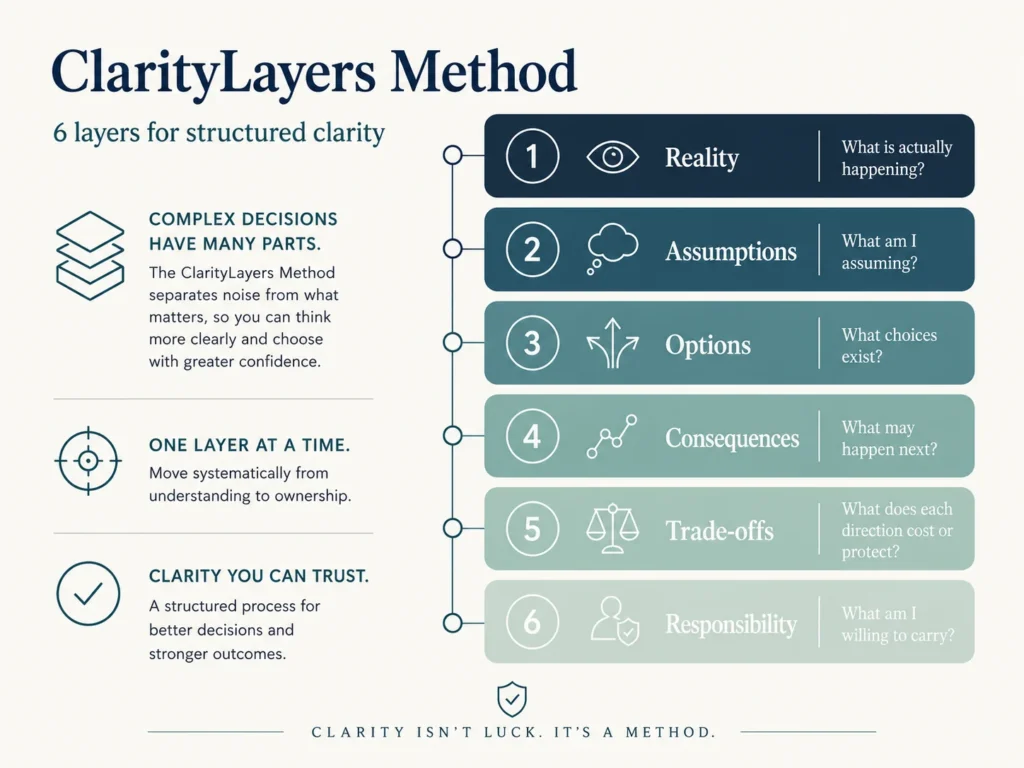
It is designed for moments of relationship uncertainty, when you are not looking for advice, prediction, or pressure. The method does not tell you what to do. It helps you see what you are actually deciding.
How it starts
Every session begins with one question:
What are you trying to decide right now?
You do not need to explain your whole relationship. You do not need to justify your feelings. You only need to name the decision that feels unclear.
That first answer becomes the starting point for the method.
The six layers
The ClarityLayers Method moves through the decision in a fixed order.
Reality
What is actually happening?
Assumptions
What are you guessing, fearing, hoping, or filling in?
Options
What choices are really in front of you?
Consequences
What could each direction change?
Trade-offs
What would each choice protect, cost, or leave unresolved?
Responsibility
What part of the decision belongs to you?
The point is not to make the decision simple. The point is to make it clearer.
A difficult relationship decision is rarely one clean problem. Facts, fear, history, hope, guilt, and possible consequences can all feel mixed together. When that happens, more advice can sometimes add more noise.
ClarityLayers works differently. It separates the decision into parts so you can look at each part without forcing a conclusion too early.
When the method is useful
The method is especially useful when:
- the same decision keeps returning
- you feel stuck between staying and leaving
- nothing is clearly wrong, but something still feels unresolved
- you are no longer sure what your relationship means
- different options carry different emotional costs
- you want to think before having an important conversation
Nothing is rushed. Nothing is pushed.
As the layers unfold, assumptions become easier to notice. Important constraints become clearer. Different options begin to separate. What first felt like one overwhelming problem often starts to show a more precise structure.
Why ClarityLayers is different
Most relationship advice starts with the question people are already afraid of:
Should I stay or leave?
ClarityLayers starts one step before that.
It does not decide whether the relationship is good or bad. It does not turn your situation into a checklist, a score, or a prediction. It helps you slow the question down enough to see what is actually inside it.
The method gives the decision a clearer shape, while the answer remains yours.
What happens at the end
At the end, you do not receive advice.
You receive three neutral scenario reflections based only on what you entered. Each reflection shows a different possible way to understand the decision, without telling you which one to choose.
The point is to help you see:
- what the real tension may be
- what each direction may involve
- what each option may protect or cost
- what responsibility may remain with you
ClarityLayers does not replace your judgment. It gives your judgment a clearer place to stand.
Privacy and starting fresh
Each session starts from zero. ClarityLayers does not store your decisions. There is no account, no history, and no saved input.
Your responses are processed in real time to generate the reflection you see. After the session ends, the input is not retained. Each decision stands on its own.
Professional use
Some people use the ClarityLayers Method before an important conversation. In professional contexts, it can serve as a neutral preparation space before therapy, coaching, mediation, or advisory discussions.
It does not diagnose, advise, or decide for you. It separates layers of thought so the conversation, wherever it happens, can begin from a clearer starting point.
The ClarityLayers Method can be described in words, but clarity usually appears when someone moves through the layers with their own situation.
Example decision
Example decision shows how the ClarityLayers Method can be applied to a real situation step by step. It makes the structure of the process easier to understand before using it with your own decision.
What this is / What it is not
What this is / What it is not explains what the ClarityLayers Method is designed to do, and what it is not meant to replace. It helps clarify the purpose, limits, and intended use of the method.
ClarityLayers offers a structured way to examine the trade-off more clearly before you decide what to do next.